
How to install windows 10 on the computer

How to install windows 10 on the computer?
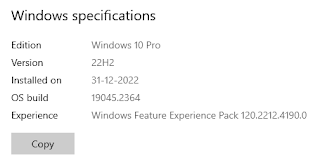
windows 10 specs

 Installing Windows 10 can be a simple process if you have the right tools and follow the correct steps. Here's a guide on how to do it:

  1. First, you'll need to download the Windows 10 installation media. You can do this by going to the Microsoft website and following the prompts to create a bootable USB drive or DVD.

  2. Once you have the installation media, you'll need to boot from it. To do this, you'll need to change the boot order in your computer's BIOS settings. Restart your computer, and press the key that allows you to enter the BIOS settings (usually F2, F10, or DEL). Navigate to the boot order menu, and set the USB drive or DVD as the first boot option. Save the changes and exit the BIOS.

  3. Your computer should now boot from the installation media. You'll be asked to choose your language and other preferences. Click "Next" to continue.

  4. On the next screen, you'll see the "Install Now" button. Click it to begin the installation process.

  5. You'll be asked to accept the license terms. Read them carefully, and then click "I accept" to continue.

  6. On the next screen, you'll be asked to choose the installation type. You can choose between an "Upgrade" or a "Custom" installation. If you choose "Upgrade," your existing files and settings will be preserved, but you may need to reinstall some of your programs. If you choose "Custom," you can create a new partition or install Windows on an empty drive. Choose the option that best fits your needs, and click "Next" to continue.

  7. If you chose a "Custom" installation, you'll be asked to select the drive or partition where you want to install Windows. Choose the appropriate option, and click "Next" to continue.

  8. The installation process will now begin. It may take some time to complete, depending on your computer's specs.

Comments

Popular posts from this blog

LeetCode 88 Explained: Four Approaches, Mistakes, Fixes & the Final Optimal Python Solution

Evolving My Solution to “Merge Sorted Array” A practical, beginner-friendly walkthrough showing four versions of my code (from a naive approach to the optimal in-place two-pointer solution). Includes explanations, complexity and ready-to-paste code. Problem Summary You are given two sorted arrays: nums1 with size m + n (first m are valid) nums2 with size n Goal: Merge nums2 into nums1 in sorted order in-place . Version 1 — Beginner Approach (Extra List) I merged into a new list then copied back. Works, but not in-place and uses extra memory. class Solution: def merge(self, nums1, m, nums2, n): result = [] p1 = 0 p2 = 0 for _ in range(m+n): if p1 >= m: result.extend(nums2[p2:n]) break elif p2 >= n: result.extend(nums1[p1:m]) break elif nu...

Introducing CodeMad: Your Ultimate Universal IDE with Custom Shortcuts

Introducing CodeMad: Your Ultimate Multi-Language IDE with Custom Shortcuts Welcome to the world of CodeMad, your all-in-one Integrated Development Environment (IDE) that simplifies coding and boosts productivity. Developed in Python, CodeMad is designed to make your coding experience smoother and more efficient across a variety of programming languages, including C, C++, Java, Python, and HTML. Whether you're a beginner or an experienced programmer, CodeMad is your go-to tool. In this blog, we'll dive deep into the workings of CodeMad, highlighting its unique features and easy installation process. The Power of Shortcuts CodeMad's intuitive interface is built around a set of powerful keyboard shortcuts that make coding a breeze. Here are some of the key shortcuts you'll find in CodeMad: Copy (Ctrl+C) : Duplicate text with ease. Paste (Ctrl+V) : Quickly insert copied content into your code. Undo (Ctrl+Z) and Redo (Ctrl+Y) : Correct mistakes and s...

Product of Array Except Self in Python | Prefix & Suffix Explained (LeetCode 238)

Problem Overview The Product of Array Except Self is a classic problem that tests your understanding of array traversal and optimization. The task is simple to state but tricky to implement efficiently. Given an integer array nums , you need to return an array such that each element at index i is equal to the product of all the elements in nums except nums[i] . The challenge is that: Division is not allowed The solution must run in O(n) time Initial Thoughts At first glance, it feels natural to compute the total product of the array and divide it by the current element. However, this approach fails because division is forbidden and handling zeroes becomes messy. This pushed me to think differently — instead of excluding the current element, why not multiply everything around it? That’s where the prefix and suffix product pattern comes in. Key Insight: Prefix & Suffix Products For every index i : Prefix product → product of all elements to t...